Thursday, August 15, 2013

Baby Massage


Baby Massage

Click for a larger image of baby massage with a dough ball Baby massage has a long tradition in India. Just after birth, a cleansing massage is done with a soft wheat-dough ball, to which a little almond oil and a dash of turmeric is added. Just before rubbing the ball is dipped in a bit of almond oil. This practice is continued for the first six days after birth, before the bath. Ayurvedic baby massage enhances circulation, helps in the expulsion of toxins and aids the digestive system of the baby.
On the seventh day after birth, actual baby massage with the dough ball starts and this goes on every day for 3 weeks. The dough ball should be dipped in oil every now and then, which helps to keep the 3 doshas in proper balance.
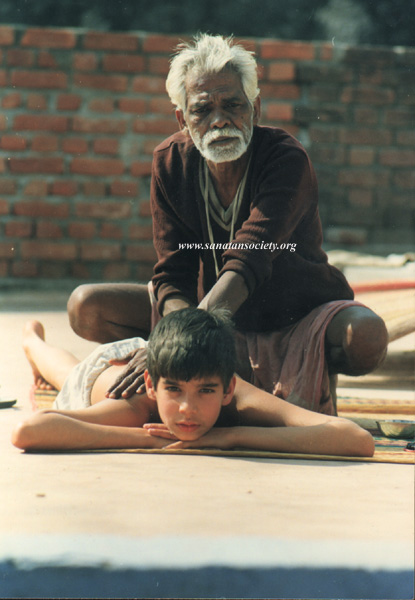
Click for a larger image of ayurvedic baby massageMassage with the hands begins when the infant is one month old, when the baby's body has become strong enough. The baby massage is continued every day for 3 months, during which the most time is spend in massaging spine, back, neck, waist, hands and feet, because these parts need to gain strength to support the body.
Once the baby starts lifting its head on its own and supporting its body weight on its arms, more general daily body massage should continue for 18 months. The massage of the spine nevertheless remains an important aspect of infant massage.
After this time, baby massage can be given on alternate days, though a daily massage routine will aid in making the child strong and happy.


Ayurvedic Massage Therapy

Ayurvedic Massage Therapy 

While ayurvedic massage therapy does not generally provide a complete therapeutic cure, it does help the organism to receive nutrient material from within the body and to expel toxins.

Certain ailments related to the muscles, ligaments and nervous system can be completely healed through good ayurvedic massage therapy. In diseases caused by deranged vata, massage therapy can also be the only remedy. In diseases caused by deranged pitta and kapha, ayurvedic massage therapy compliments other healing methods.
In ayurvedic massage therapy, the practisioner mostly works with the knowledge of the marmas or indian pressure points.
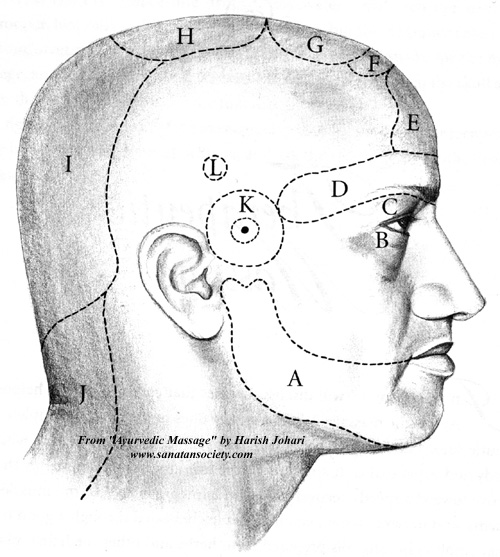
Ayurvedic massage therapy is an ideal remedy for pain. The figure below show parts of the head as they relate to other body parts and/or symptoms of diseases :
Pain here indicates
A : Tension and infections of the gums and teeth.
B : Overacidity (pain of the eyeball).
C : Gastritis (pain of the eye socket).
D : Inflammation of the stomach.
E : Ulcers
F : Disorders of the intestines.
G : Disorders of the fallopian tubes.
H : Kidney disorders.
I : Disorders of urinary tract.
J : Neuralgia.
K : Formation of cataract.
L : Disorders of the brain and the spinal nerves.
Ayurvedic massage therapy on these areas can at the least help the rest of the medical treatment to succeed.
Ayurvedic massage therapy can be a real cure in case of arthritis, rheumatism, neurasthenia, high or low blood pressure, sciatica, paralysis, polio and insomnia. In all these cases, the massage practisioner should however also prescribe specific medication, changes in daily habits, excercises, etc..
In ayurvedic massage, massage tables are rarely used. Instead of using a massage table, the massage practitioners create a massage mat, usually by placing a reed mat upon an indian-style futon, a cotton mattress. The massage mat made of reeds prevents oil from dripping upon the futon below. A massage cushion is also rarely used - the head is usually not supported. Massage chairs can be used for massages given in the sitting position (shoulders, arms, haed) in case patients are not comfortable in a cross-legged sitting position on the massage bed.


Ayurvedic Massage Oils


Ayurvedic Massage Oils 

Why use any massage oils at all ? If the body is rubbed dry, the friction created generates heat and pain, which aggravates the element of vata (wind) and thus disturbs the gasses in the body.

Massage oils eliminate friction and disperse heat evenly through the body. Massage oils are a nutrient for the skin and strengthen the nerve fibers that are connected to the hair follicles. The small amount of massage oils remaining on the skin afterwards, and after the shower or bath that follows, provides resistance to environmental temperatures and pressures. Application of massage oils to the navel before going to sleep cures dryness of the whole body. When massage oils are applied at the junction of spine and skull, they calm the entire nervous system, strengthen memory and improve the eyesight.
Many types of massage oils are used in Ayurvedic massage. For general body massage, mixed formulas of massage oils are widely used in ayurvedic massage, of which some examples : Massage oils for women and children : To 4 cups of sesame oil, add 2 tablespoons each of almond oil, wheat germ oil and jasmine oil.
Massage oils for men : To 4 cups of sesame oil, add 2 tablespoons of mustard oil, heated with ½ a teaspoon of asafoetida. Filter the mustard oil, then add 3 tablespoons of turmeric (kurkuma) powder and cook until the turmeric turns dark brown. Then add to the sesame oil.
The following massage oils are primarily used to stabilise an aggravated or simply dominant dosha :

Aggravated or dominant dosha Primary massage oils
Vata Sesame
Pitta Coconut
Kapha Mustard or Olive
Individual massage oils may have particular therapeutic use, such as Babuna (Chamomile) oil for relief of muscular pains or coriander oil that removes excess body heat. Some indian formulas for massage oils have becomes particularly popular, such as Bringaraj oil, Brahmi oil and Mahanarayana oil.


Ayurvedic Massage Techniques

Ayurvedic Massage Techniques

These massage techniques provide relaxation, circulation and elimination of toxins. If adopted as a daily practice, Ayurvedic massage techniques can even help to rejuvenate the body.
In ancient times, ayurvedic clinics did not regularly offer massage, as everybody gave and received it. Only when patients needed a particular treatment were they referred to specialists that used the appropriate ayurvedic techniques.
Today in India, practitioners roam the public places in great number and give head and body a go for a few rupees. Although they often have little knowledge of Ayurveda they do know how to work with muscles, joints and bones. Many have received training based on the massage developed by wrestlers.
Ayurvedic doctors who were also wrestlers developed a special system of their own that contained the knowledge of the Ayurvedic and Undani (Greek) systems of medicine. These traditional indian massage techniques are based on the ayurvedic doshas and marmas (pressure points like in reflexology). They also include Muslim massage techniques with pressure points called Muqame Makhsoos.
Specific ayurvedic massage techniques have also been developed for massage therapy, used in certain therapeutic treatments like in pancha karma purification. These massage techniques should only be practiced in a particular disease condition under supervision of an ayurvedic doctor or vaidya.
Lakshmi gives Vishnu a foot massage - click to see a bigger imageIn rural areas, weekly massage is still a family scene. People in India enjoy it - they know that like a best friend it brings joy and relaxation. The popular image of Vishnu reclining on a serpent and receiving foot massage from his consort Lakshmi shows it as a favorite pastime even of the gods.
Massage techniques can also help to maintain a loving relationship between husband and wife. After this kind of soothing relaxation, it is easier to share and give love. Before marriage it is one of the few ceremonial massages in the Hindu tradition that is compulsory even today. Ubtan Beauty Massage is also very popular.
It is also often used to help the aged and special techniques have been developed for young mothers as well as babies. Babies are typically massaged with a small dough ball dipped in vegetable oil.
ayurvedic massage oils are essential to any massage.
In ayurvedic massage, massage tables are rarely used. Instead of using a massage table, the massage practitioners create a massage mat, usually by placing a reed mat upon an indian-style futon, a cotton mattress. The massage mat made of reeds prevents oil from dripping upon the futon below. A massage cushion is also rarely used - the head is usually not supported. Massage chairs can be used for massages given in the sitting position (shoulders, arms, haed) in case patients are not comfortable in a cross-legged sitting position on the massage bed


Ayurvedic Treatment in Sri Lanka for Joint dislocation

Ayurvedic Treatment in Sri Lanka for Joint dislocation
Joint dislocation, or luxation (Latin: luxatio), occurs when bones in a joint become displaced or misaligned. It is often caused by a sudden impact to the joint. The ligaments always become damaged as a result of a dislocation.
- Occurrence
Although it is possible for any joint to become subluxed or dislocated, the most common sites it is seen in the human body are:
  • Shoulders (see Dislocated shoulder),
  • Fingers,
  • Knees,
  • Wrists (most likely be accompanied by a fracture.)
  • Elbows (most likely be accompanied by a fracture.)
- Our Treatments
Anyone experiencing a joint dislocation should seek medical assistance as soon as possible. A dislocated joint can only be successfully 'reduced' into its normal position by a trained medical professional. Trying to reduce a joint without any training could result in making the injury substantially worse.
X-rays are usually taken to confirm a diagnosis and detect any fractures which may also have occurred at the time of dislocation.
Doctor sets the bone alignment using traditional ayurvedic procedures.
Ayurvedic bandages using traditional herbal medicines are used for immobilisation.
Doctor then works on restoration of the body movements. Move top

Ayurvedic Treatment for Slipped Disc (Disc Herniation)
-About Slipped Disc
A spinal disc herniation (prolapsus disci intervertebralis), incorrectly called a "slipped disc", is a medical condition affecting the spine, in which a tear in the outer, fibrous ring (annulus fibrosus) of an intervertebral disc (discus intervertebralis) allows the soft, central portion (nucleus pulposus) to bulge out.
The popular term "slipped disc" is quite misleading, as an intervertebral disc, being tightly sandwiched between two vertebrae, cannot actually "slip," "slide," or even get "out of place." The disc is actually grown together with the adjacent vertebrae and can be squeezed, stretched, and twisted, all in small degrees.
  • Cervical Disc Herniation
  • Lumbar Disc Herniation
- Causes - Slipped Disc
Disc herniations can occur from general wear and tear, such as jobs that require constant sitting, but especially jobs that require lifting. Traumatic (quick) injury to lumbar discs commonly occurs from lifting while bent at the waist, rather than lifting while using the legs with a straightened back.
Herniation of the contents of the disc into the spinal canal often occurs when the front side (stomach side) of the disc is compressed while sitting or bending forward, and the contents (nucleus pulposus) get pressed against the tightly stretched and thinned membrane (annulus fibrosis) on the rear (back side) of the disc.
- Symptoms - Slipped Disc
Symptoms of a herniated disc can vary depending on the location of the herniation and the types of soft tissue that become involved. They can range from little or no pain if the disc is the only tissue injured, to severe and unrelenting neck or low back pain that will radiate into the regions served by affected nerve roots that are irritated or impinged by the herniated material. Other symptoms may include sensory changes such as numbness, tingling, muscular weakness, paralysis, paresthesia, and affection of reflexes. If the herniated disc is in the lumbar region the patient may also experience sciatica due to irritation of the sciatic nerve. Unlike a pulsating pain or pain that comes and goes, which can be caused by muscle spasm, pain from a herniated disc is usually continuous.
- Diagnosis - Slipped Disc
Diagnosis is made by Dr Wijesinghe, the ayurvedic medical practitioner based on the history, symptoms, and physical examination.
- Our Treatment
Dr treats slipped disc conditions with age old ayurvedic treatments. Ayurvedic doctors generally diagnose using Sanskrit medical texts. Severe back pain in Ayurveda is called Kadeegraham (Lumbago). Slip Disc is a very serious medical condition which comes under this group of aliments called Kadeegrahom. In ayurveda it can be called Sandhivislesham or Asthi Chyudi (Sanskrit words for Slip Disc or Herniated Disc)

Ayurvedic Treatment for Slipped Disc (Disc Herniation) Move top
Cervical and Lumbar Spondylosis
-About Cervical & Lumber Spondylosis
Spondylosis is degenerative arthritis, osteoarthritis, of the spinal vertebra and related tissue. If severe, it may cause pressure on nerve roots with subsequent pain or paresthesia in the limbs.
- Symptoms
When the space between two adjacent vertebrae narrows, compression of a nerve root emerging from the spinal cord may result in radiculopathy (sensory and motor system disturbances, such as severe pain in the neck, shoulder, arm, back, and/or leg, accompanied by muscle weakness). Less commonly, direct pressure on the spinal cord (typically in the cervical spine) may result in global weakness, gait dysfunction, loss of balance, and loss of bowel and/or bladder control.

The patient may experience a phenomenon of shocks (paresthesia) in hands and legs because of nerve compression and lack of blood flow. If vertebrae of the neck are involved it is labelled cervical spondylosis. Lower back spondylosis is labeled lumbar spondylosis.
Cervical and Lumbar Spondylosis
- Diagnosis
Diagnosis is made by Dr Wijesinghe, the ayurvedic medical doctor based on the history, symptoms, and physical examination.
- Our Treatment
Setting the congested part of the cervical region by the doctor's traditional techniques and do fermentation with the traditional medicines and apply our own medicines over the affected region.
- Greeva Vasthi
In this treatment we keep a ring-type system over the affected vertebra and keep ayurvedic herbal medicines over it.
We give oil bath therapy, Herbal massage and we also prescribe oral medicines.

Ayurvedic Treatment for Slipped Disc (Disc Herniation)

Wednesday, August 14, 2013

Ayurvedic remedies for diabetes cure

Ayurvedic remedies for diabetes cure

Here're are Ayurvedic remedies for diabetes cure. 1. Heal with bitter gourd: The bitter gourd is regarded as the best remedy for diabetes. Drink at least one tablespoon of bitter gourd juice daily. It will reduce blood sugar levels in your blood and urine. You can take bitter gourd dried
2. Gooseberry juice: A tablespoon of Indian gooseberry juice mixed with a cup of fresh bitter gourd juice, taken daily for two months will enable the pancreas to secrete insulin.
3. Tulsi and neem wonder: Drinking a glass of water with 10 tulsi leaves, 10 neem leaves and 10 belpatras early morning on an empty stomach helps in keeping sugar levels under control. Also, put one cup water into a copper vessel at night and drink the water in the morning.
4. Turmeric is beneficial: Mix and grind seeds of fenugreek (100gm), turmeric (50gm), white pepper. Take one teaspoon of this powder with a glass of milk twice daily.
5. Gourd vegetable: Have bitter gourd cooked in vegetable oil for a period of three months. It will bring down sugar levels.

Comment of people of Cure for Diabetes

Cure for Diabetes? … Unbelievable but its true

I am Mr. Ramesh Bhat aged 54 yrs, was suffering from Diabetes and now got a complete cure from it at Shathayu Ayurvedic Centre. Since 3 years no diabetes, yes it is unbelievable but true, I got cured of Diabetes.
In the year 2004, I have been diagnosed diabetic at Apollo Hospital, Chennai,
my blood sugar level being 396 mg/dl on fasting and 464 mg/dl on post-parandial. They started treatment with Tab. Glucored Forte, three times a day added with required Vitamins. In the meantime, one of my friend recommended me to
Dr. Mruthyunjaya at Shathayu Ayurvedic Centre, who in turn posed me a challenge after seeing my reports that he will cure my diabetes. Initially he put me on with Ayurvedic medicines along with allopathic drugs and subsequently started withdrawing allopathic drugs step by step, then he stoped allopathy drugs completely in the span of 10 months. Every time while reducing this, he asked me to check my sugar level and was kept under control. Finally withdrawn even Ayurvedic medicines also. It totally took a year and half, my diabetic got cured. Since then I am not taking any Ayurvedic & allopathic medicine for diabetes. My blood sugar level is very much under control, in spite of me consuming sweets. Now, it is almost three years, that I am not having Diabetic problem, the credit goes to Dr. Mruthyunjaya of Shathayu Ayurvedic Centre.
As a proven case, I am pleased to advice those of you, who want to try for getting a better solution for your diabetic problem, please approach Dr. Mruthyunjaya at Shathayu Ayurvedic Centre.
Mr. Ramesh Bhat